
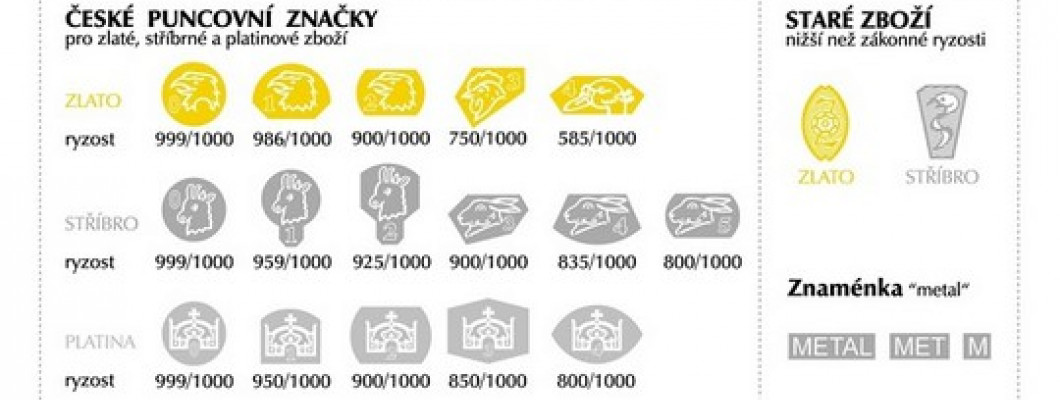
Currently used Czech hallmarks for gold, silver and platinum jewellery.
Hallmarks indicate the fineness. The hallmark has the form of a three-digit numerical code. It serves to quickly identify the type and fineness of the metal from which the jewellery is made. The hallmark is stamped on the product by an institution independent of the manufacturer or trader. In our country, this function is represented by the Hallmarking Office.
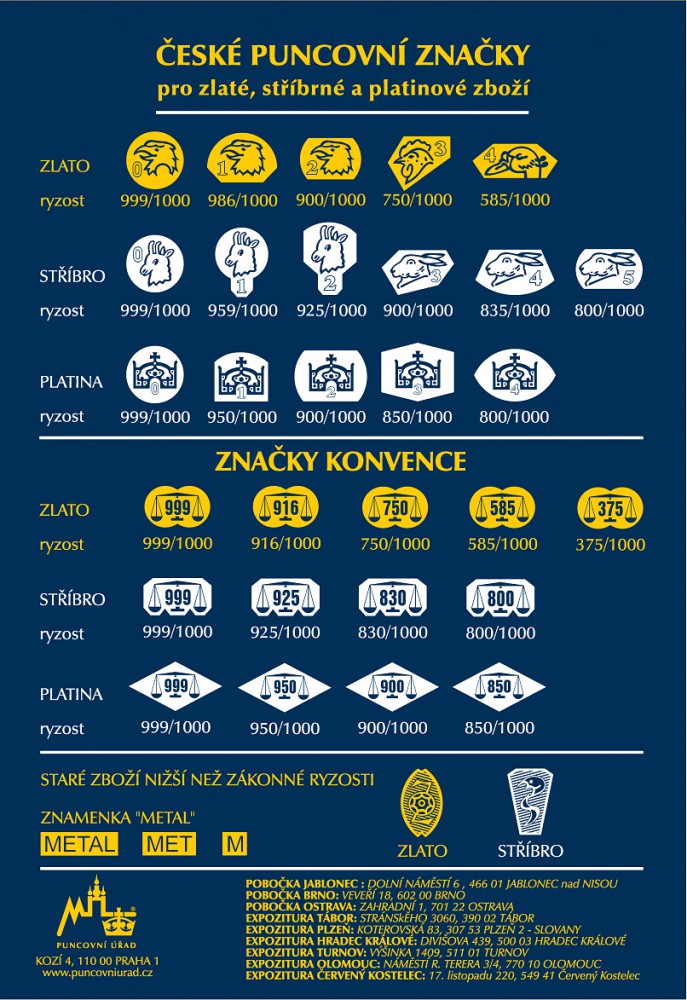
For gold jewellery, you will most often encounter the code 585, or 585/1000, which indicates 14-carat gold. This combination of numbers is not random, as it might seem at first glance. The amount of precious metal is stated in thousandths and the alloy is 585/1000 gold. Converted to a percentage, this is 58.5% gold in the alloy. For 18-carat gold, the code 750/1000 is used, which also indicates that the metal used contains 75% gold.
Overview of fineness designations:
585/1000 - this is 14-carat gold, which contains 585 parts of pure gold and 415 parts of other metals.
750/1000 - 18-carat gold. It contains 750 parts of gold and 250 parts of other metals.
1000/1000 - this is pure gold with a purity of 24 KT.
1KT = 1/24 of the gold content in the alloy.
Current silver jewelry usually bears the hallmark 925/1000, which indicates that it is so-called sterling silver. It contains 92.5% pure silver and only in combination with another type of metal, most often copper, does it become stronger and more durable. Markings of lower fineness, such as 800/1000, can be found on older jewelry or on utility items.
In addition to the basic information that the hallmarked item was checked and found to be of correct fineness, Czech hallmarks also indicate the metal used, its fineness, and the period when the hallmark was struck.
In newer hallmarks, the letters in them also indicate the workplace that carried out the inspection and marking.
P - Prague, J - Jablonec nad Nisou, B - Brno, O - Ostrava, T - Turnov, R - Tábor, Z - Plzeň, L - Olomouc, H - Hradec Králové, K - Červený Kostelec.
These letters are located near the fineness number and are oriented perpendicular to the vertical axis of the mark. Goods are considered to be properly hallmarked regardless of the workplace or office that marked them and no additional testing or marking is required.
In addition to the current Czech hallmarks, all hallmarks that were valid in the history of Czechoslovakia and did not express a lower fineness than the lowest fineness for individual precious metals specified in the hallmarking act (§3, paragraph 2) are valid. That is, the Austro-Hungarian, Czechoslovak, protectorate and Slovak State hallmarks. An example is the hallmark called čejka, used until 1993 for a fineness of 585/1000. However, hallmarks that were introduced during World War II in Czechoslovak territory occupied by foreign states (Austrian, Polish and Hungarian hallmarks) are not valid. Other valid historical hallmarks are published in the brochure Ing. Bouši "List of hallmarks valid in the territory of the Czech Republic", which was first published in 2008 and supplemented as part of the reissue in 2018. It is available at every workplace of the Assay Office.
After the Czech Republic joined the EU, hallmarks of some EU member states were gradually recognized. As of the date of updating this text (January 6, 2016), these are selected hallmarks of Estonia, Finland, Croatia, Ireland, Cyprus, Lithuania, Latvia, Hungary, Malta, Poland, Portugal, Slovakia, Slovenia and Great Britain.
Czech hallmarks - table
This issue does not concern investors in bullion and coins made of precious metals